
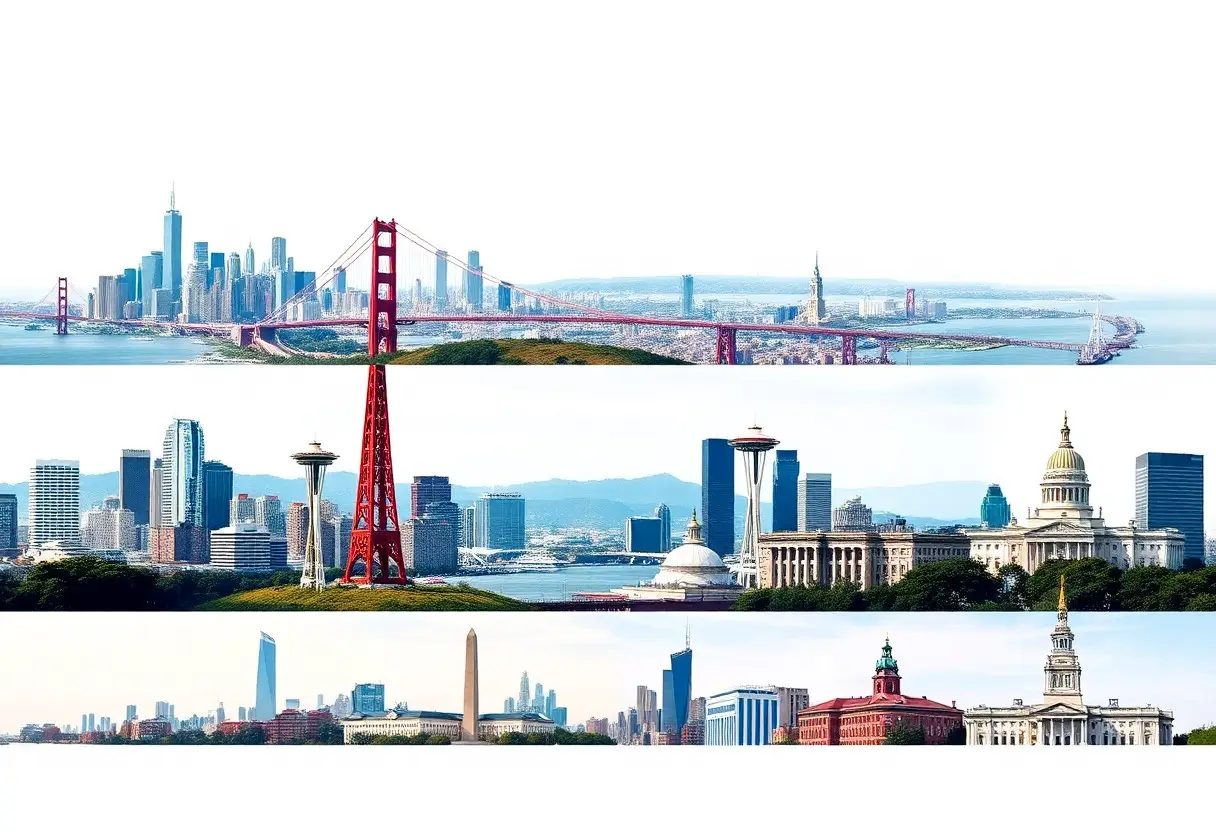
Cities like New York, San Francisco, and Boston stand out for their intense job markets, sky-high living costs, and relentless pace of innovation. You face steep challenges in these hubs, from cutthroat industries to overcrowded housing. Yet, they also offer unmatched opportunities for growth, career advancement, and access to top-tier networks that shape the nation’s future.
Key Takeaways:
- New York City leads in overall economic competitiveness due to its concentration of financial services, tech startups, and global corporate headquarters.
- Silicon Valley’s influence lifts San Jose and San Francisco into the top tier, driven by innovation, high venture capital investment, and a dense network of tech talent.
- Cities like Austin and Seattle have risen in rankings thanks to rapid population growth, strong job markets, and expanding industries in technology and clean energy.
New York City
Global financial powerhouse
Wall Street sets the pace for global markets, and you feel its pulse in every corner of New York City. As the home of the New York Stock Exchange and Federal Reserve Bank, the city commands the largest financial sector in the nation. International capital flows through its institutions, making it a high-stakes environment where competition drives innovation-and burnout. The pressure to perform here is relentless, but so are the rewards for those who thrive.
Diverse talent pool
You’ll find more languages spoken in New York than in most countries, and that diversity fuels its workforce. Over 3 million residents hold bachelor’s degrees or higher, drawn from every continent. This convergence of backgrounds creates a dynamic, fast-moving labor market where ideas clash and evolve rapidly. The city’s openness attracts global talent, but it also intensifies competition for top roles.
Immigrants make up nearly 40% of New York’s population, and their contributions span tech, healthcare, finance, and the arts. This constant influx sustains innovation but also exposes fault lines-wage disparities and housing shortages can make inclusion more theoretical than real. Still, the sheer range of skills and experiences available gives New York an unmatched edge in solving complex challenges. You’re not just hiring talent-you’re tapping into a global network rooted in one city.
San Francisco
Technology innovation leader
You stand at the heart of where modern tech is born. San Francisco drives global innovation, home to giants like Salesforce and Uber, and countless startups shaping how people live and work. The city’s culture rewards disruption, attracting top engineers and visionary founders eager to redefine industries. This relentless pace makes competition fierce-not just for talent, but for space, attention, and survival.
High venture capital
You’re in the city that pulls in more venture capital than nearly any other metro in the U.S. Investors flood startups with funding, betting big on the next unicorn. This influx fuels rapid growth-but also inflates expectations and valuations dangerously high. Failure here is not just personal; it can be public and costly.
Behind the numbers, the reality is stark: over 60% of venture dollars in Northern California flow into San Francisco startups. This concentration creates intense pressure to scale quickly, often at the cost of sustainable business models. You face a market where funding can vanish overnight if momentum stalls.
Boston
Elite educational institutions
You’re surrounded by some of the most prestigious universities in the nation when you walk through Boston. Harvard and MIT anchor a dense network of colleges that attract top students and faculty worldwide. These institutions don’t just shape minds-they fuel innovation, entrepreneurship, and a culture of intellectual intensity that permeates the city. Competition for admission is extremely high, mirroring the city’s broader drive for excellence.
Biotech research hub
You’re standing in the epicenter of American biotechnology, where labs and startups thrive side by side. Boston’s biotech corridor benefits from massive research funding and deep ties to its academic powerhouses. The concentration of talent and venture capital creates a high-pressure, high-reward environment where breakthroughs happen-but so do cutthroat rivalries.
Boston’s biotech dominance comes with real stakes: rapid growth has driven up lab space costs, making access dangerously unaffordable for smaller startups. Yet the payoff is undeniable-gene editing, cancer therapies, and AI-driven drug discovery are advancing faster here than almost anywhere else. You’re witnessing a cluster where scientific ambition meets intense competition, and the margin between success and failure is razor-thin.
Chicago
Major transportation center
Chicago sits at the heart of America’s transportation network. You’re at the crossroads of seven major interstate highways and the nation’s busiest rail hub, moving over half of all U.S. freight trains annually. O’Hare International Airport, one of the busiest airports in the world, connects you directly to global markets. This unmatched access makes delays rare and logistics efficient for businesses across sectors.
Diverse industrial economy
You’ll find Chicago’s economy anchored in a broad mix of industries-from manufacturing and food processing to finance and tech. The city hosts more Fortune 500 companies than any other U.S. city outside New York. Its resilience during economic downturns stems from this diversity, reducing dependence on any single sector. Even as traditional industries evolve, Chicago adapts with strong innovation in healthcare and renewable energy.
Chicago’s industrial strength lies in its ability to balance legacy sectors with emerging fields. While steel and rail remain active, you see rapid growth in biotech and data centers. The danger of underinvestment in infrastructure threatens this momentum, but public-private partnerships are stepping in. You benefit from a skilled workforce and proximity to major markets, making Chicago not just diverse, but durable.
Seattle
Seattle stands as a powerhouse of innovation and economic intensity, driven by a unique blend of tech dominance and industrial strength. You see its skyline shaped not just by mountains and water, but by the towering influence of global technology leaders rooted here. The city’s competitive edge comes from its ability to merge digital advancement with tangible production, making it a standout in the national economy.
Cloud computing giants
Seattle is the home base for Amazon Web Services, the largest cloud computing provider in the world. This dominance gives the city unmatched influence over global digital infrastructure. You’re surrounded by a dense network of engineers, startups, and data centers that thrive on AWS’s ecosystem. The concentration of cloud talent here creates intense competition for skilled workers and pushes real estate and innovation costs higher.
Strong manufacturing base
Seattle’s industrial legacy remains strong through aerospace manufacturing, led by Boeing’s massive presence in the region. You’ll find thousands employed in high-precision production, from commercial jets to advanced avionics. This sector resists the full shift to a service-only economy, anchoring the city’s workforce in tangible, high-value output.
Boeing’s Everett factory is the largest building in the world by volume, a symbol of Seattle’s enduring industrial might. While automation and global supply chains pose serious risks to job stability, the skill level required in aerospace manufacturing keeps wages above average. You benefit from a rare U.S. city where coding and welding carry equal economic weight.
Austin
Rapid tech sector growth
You see tech companies flooding into Austin at a pace unmatched in most U.S. cities. Major players like Tesla and Apple have expanded operations here, drawn by talent and infrastructure. This surge has intensified competition for skilled workers, pushing wages up and startups to innovate faster just to keep pace. The city’s transformation into a Silicon Hills rival is no longer a trend-it’s a full-scale shift.
Favorable business climate
You benefit from Texas’s lack of state income tax and relatively low regulatory burden, making Austin a magnet for entrepreneurs. The city offers grants, incubators, and streamlined permitting, reducing barriers to entry for new ventures. This environment fuels rapid company formation, especially in software, energy tech, and hardware.
Local policies actively reduce red tape for small businesses, and municipal incentives target job-creating startups. However, this ease of entry has led to market saturation in some sectors, increasing the risk of early-stage failure due to overcrowding and rising operational costs. You must differentiate quickly to survive.
Washington D.C.
Federal government proximity
You operate in a city where power is concentrated just blocks from K Street. The proximity to federal agencies, Congress, and regulatory bodies gives Washington D.C. unmatched influence. Decisions made here ripple across industries nationwide. This direct access intensifies competition, as firms race to shape policy, secure contracts, and gain insider insight before rivals do.
Specialized professional services
You’re surrounded by elite law firms, lobbying groups, and consulting agencies that thrive on influence. These firms specialize in regulatory affairs, government relations, and compliance-areas where even minor missteps can carry legal or financial consequences. The demand for precision and discretion fuels fierce competition for top talent and high-stakes clients.
Specialized professional services in D.C. are not just about connections-they demand deep expertise in navigating complex federal systems. You must understand legislative timelines, agency rulemaking, and political shifts better than your competitors. Firms that anticipate changes before they happen dominate the market, while those slow to adapt risk irrelevance in this high-pressure environment.
Dallas
Corporate Headquarters Density
You see corporate power concentrated in Dallas like few other American cities. The metro area hosts over 20 Fortune 500 headquarters, ranking second nationally. This density fuels economic resilience and attracts high-level talent. Companies like ExxonMobil, AT&T, and Texas Instruments anchor a business ecosystem where decisions shaping global markets are made daily. The clustering effect amplifies investment, innovation, and influence.
Robust Labor Market
You operate in a labor market defined by growth, diversity, and opportunity. Dallas added over 40,000 jobs in the past year alone, outpacing the national average. Unemployment remains below 4%, signaling intense demand for skilled and entry-level workers alike. Industries from tech to logistics compete fiercely for talent, driving up wages and benefits.
The strength of Dallas’s labor market lies in its adaptability. You benefit from a young, mobile workforce drawn by low living costs and expanding industries. Dangerous imbalances emerge in wage gaps and housing affordability, threatening long-term inclusivity. Yet, continuous employer investment in training and infrastructure signals sustained momentum. You’re positioned where opportunity meets urgency.
Atlanta
Atlanta stands as a powerhouse of economic momentum, driven by strategic advantages few cities can match. Its central location, world-class infrastructure, and dynamic workforce make it a magnet for industries shaping the future. You see this energy in two key sectors: logistics and supply chain, and a rapidly expanding fintech ecosystem.
Logistics and supply chain
Atlanta is the logistics heartbeat of the Southeast, anchored by Hartsfield-Jackson Airport-the world’s busiest. This gives you unmatched air cargo capacity and rapid access to domestic and global markets. Major distribution hubs from UPS and Amazon reinforce the city’s dominance. With interstate crossroads converging at I-75, I-85, and I-20, freight moves faster here than in nearly any other U.S. metro.
Emerging fintech ecosystem
You’re witnessing a fintech surge in Atlanta, where startups and legacy institutions coexist in a competitive, innovation-driven environment. The city ranks among the top three for fintech employment, fueled by a growing talent pool from local universities and strong support from financial giants like Global Payments and SunTrust. Venture capital is flowing, and incubators are multiplying.
What makes Atlanta’s fintech rise especially significant is its inclusivity-many startups focus on underserved communities and financial equity, turning social impact into scalable business models. This isn’t just growth; it’s growth with purpose. You’re seeing homegrown companies like Bond and Kabbage redefine digital banking and lending, proving Atlanta isn’t just catching up-it’s setting the pace.
To wrap up
Summing up, you now know the 10 most competitive cities in the US based on economic strength, innovation, workforce quality, and infrastructure. These cities set the standard for business growth, attracting top talent and investment. You see clear patterns-coastal hubs dominate, but inland cities are rising with strong tech and education sectors. Your understanding of what drives urban competitiveness gives you an edge in making informed decisions, whether for relocation, investment, or career planning. Each city offers distinct advantages shaped by industry focus and local policy.
FAQ
Q: What factors make a city one of the most competitive in the U.S.?
A: A city’s competitiveness is measured by economic strength, job market activity, innovation levels, education quality, infrastructure, and cost of living. Cities like San Francisco and New York lead due to high concentrations of tech firms, financial institutions, and top universities. Strong labor markets, high startup formation rates, and access to venture capital also play key roles. Places with growing populations and high productivity tend to rank higher because businesses and skilled workers are drawn to environments where opportunity and resources are concentrated.
Q: Which cities consistently rank among the top 10 most competitive in recent studies?
A: San Jose, California, often ranks first due to its position at the heart of Silicon Valley and its high median income and tech employment. San Francisco, Seattle, Boston, and New York City follow closely, driven by innovation, research institutions, and diverse economies. Washington, D.C., ranks high for government-related tech and professional services. Austin, Denver, Dallas, and Raleigh also appear regularly, thanks to business-friendly policies, population growth, and expanding tech and healthcare sectors. These cities combine strong job growth with relatively high standards of living.
Q: How does cost of living affect a city’s competitiveness despite high rankings?
A: High costs can challenge a city’s long-term competitiveness even if it ranks highly. In San Francisco and New York, for example, housing prices and daily expenses can outpace wage growth, pushing out middle-income workers and small businesses. This imbalance may reduce workforce diversity and strain public services. Some lower-cost cities like Austin and Raleigh gain ground by offering strong job markets with more affordable housing. Competitiveness isn’t just about economic output-it also depends on whether people at all income levels can live and thrive in the city.